Sliders – knowledge compendium in questions and answers

What are overhead cranes?
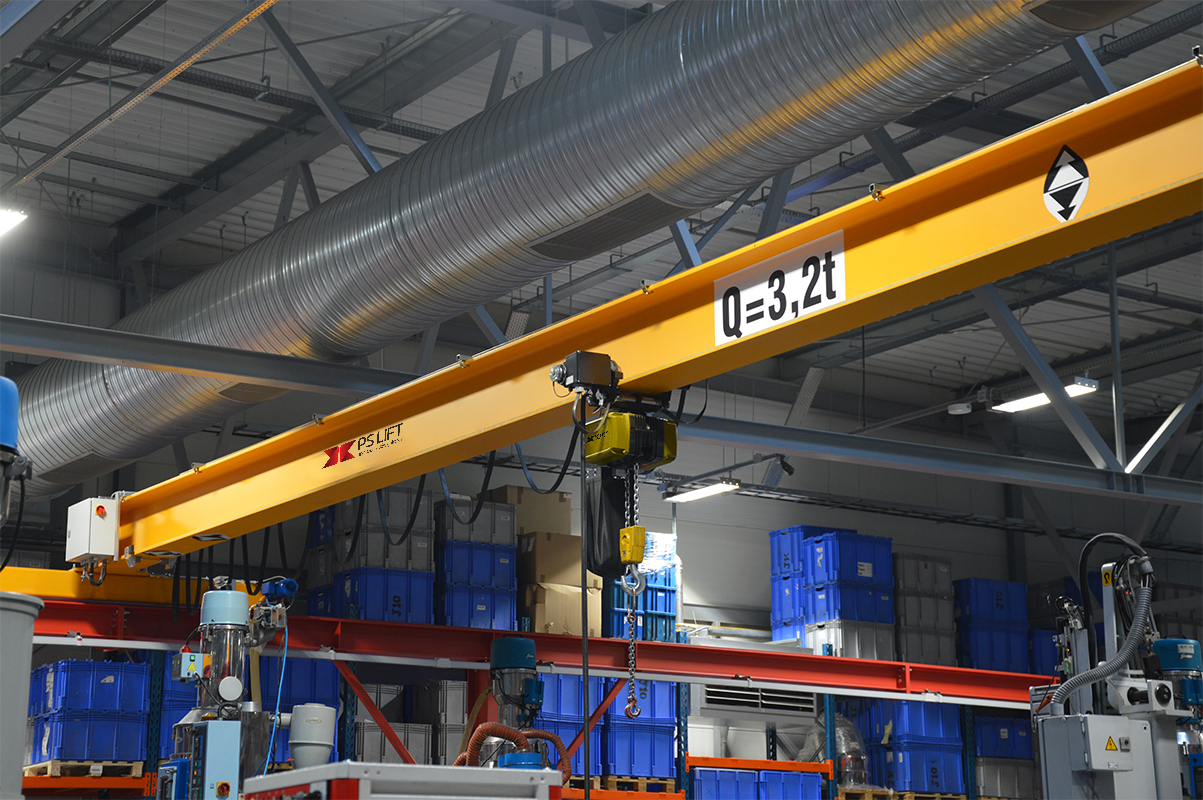
The cranes are a kind of lift-transport equipment that works in intermittent traffic. The structure of the crane consists of a supporting part – that is, a bridge that moves on the tracks and a hoist or winch that passes the bridge, carrying loads vertically or horizontally. The range of movements a load can make is limited by the length of the track and the span of the bridge. The cranes allow very heavy loads to be carried, so they are used in production plants, in transport, as well as in the warehouse and handling industry. All overhead cranes shall be controlled by the Technical Supervision Authority.
What does the classification look like? cranes?
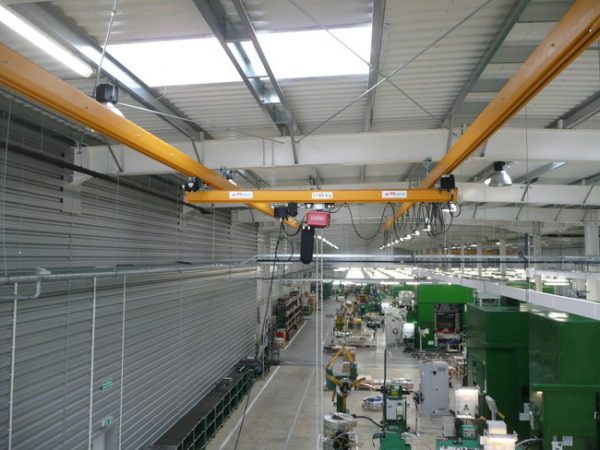
Overhead cranes can be classified in several ways. When classifying them by their structural design, the main types include all overhead craneswhere the load-bearing part is based directly on the upper track and suspended overhead cranes where the bridge hangs from the bottom of the track. We divide the overhead cranes into two subcategories – single girder and double girder cranes. Similarly, we share suspended cranes.
Besides, we can distinguish the cranes:
- gantry cranes (also referred to as: gate winches or portal cranes) – the supporting part is based on the track by means of a support,
- semi-gate – based on one side on the road track and on the estakade,
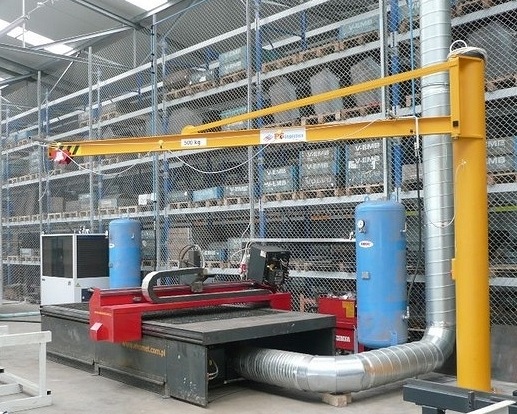
- brackets — load-bearing part has the shape of a bracket,
- column – look like a bridge, but have an additional column,
- modular – light, consisting of semi-closed modular profiles and a joint suspension system which is attached directly to the ceiling. Thanks to this construction, the crane can be easily rebuilt.
We can also share our cranes, given the type of bridge – then we have three categories. Single girder, double girder and multi girder cranes. And speaking of girders, their design can also affect the classification of cranes – we distinguish cylindrical, truncated and metallurgical girders.
However, the structure is not the only criterion for classification of cranes. We also share them because of Type of drive – hand cranes, electric/hand cranes, electric, hydraulic and pneumatic cranes must be replaced.
Another criterion is use of overhead cranes. . . The application includes universal cranes, and process cranes, i.e. dedicated to specific tasks. Process cranes include:
- gripping cranes,
- gripping cranes,
- funnel cranes,
- Batch cranes,
- catch cranes,
- tick cranes,
- Forging cranes
- Striper cranes.
We can also divide the cranes due to the way they are controlled. This division includes cranes controlled from the cab, operated from working level, wirelessly controlled, and automatically controlled.
What are the most important technical parameters of cranes?
Q [t] – load capacity. This is the maximum load that a given overhead crane can lift under specified conditions. It includes the weight of load-handling attachments such as grabs, clamps and lifting beams. The hook and other non-removable crane components are not included.
H [m] – lifting height. This parameter indicates the height from the working level to the gripping device at the top. In the case of bridge cranes, the lift height shall be counted from the ground level.
L [m] – the span of the crane, i.e. the distance between the axles of the rails.
The rate of discharge/lifting of the load – given in metres per second. This value refers to a load with a mass equal to the crane load during lifting.
The speed of the hoist/ winch – also given in meters per second. This value determines the speed that a crane can achieve by moving in a plane with a load, at a wind speed of less than 3 m/s.
The load group – from A1 to A8, depends on the number of cycles and load state of the device at a specified time.

Who can become a crane operator?
To get a job as a crane operator, you have to meet the basic requirements of employers. In this position it is necessary to have the powers conferred by the Office of Technical Supervision. The type of permission required varies, depending on what kind of cranes we are supposed to operate.
What are the rating categories for crane operators?
The rules shall take into account two categories of rating for overhead crane operators.
Category I S – applies to cranes cabin-controlled as well as category I W hoists and winches and cranes in category II S.
Category II S — includes general-purpose overhead cranes which are operated from a working level. It also applies to hoists and winches.
What are the obligations of the operator cranes?
The primary task of the crane operator is to move loads using this lift device. It must operate the catch device (hook) with precision. It is also important that he is able to cope well with the elements used to securely attach the load. The operator is also responsible for the technical condition of the entire crane and the equipment used in operation.
What are the operator’s earnings cranes?
The salary depends on the experience and experience of work, but on average, at the beginning of this year the crane operator could count on a salary of PLN 3 100 gross. On the other hand, those operators who made the best money could expect a salary of over PLN 3 700 gross. When considering whether it is worth to be educated as a crane operator, it is worth considering that these devices are used properly in every branch of the industry. Finding a job won’t be a problem for us anymore. As a crane operator, we can hire in warehouses, warehouses, large production plants or in handling companies.
Is the operator’s work cranes Is she safe?
Every physical work involves a certain type of threat. An operator can be affected by noise at the factory or bad lighting. On the other hand, if it works outside, it can be unpleasant to change atmospheric conditions. The risk also involves excessive physical effort, or spending many hours in one position. The greatest danger is to be crushed by heavy loads. However, if we follow the principles of health and safety, such work will not pose any threat to us.
What can you do to become a crane operator?
It is necessary to obtain the powers granted by the Technical Supervision Office (UTT). In order to gain these privileges, we have to take the exam before I’m a committee. We will best prepare for such an exam during special training for crane operators. Those conducting such a course will also take care of the formalities related to the organisation of the exam. As part of such training, we learn not only the theory that allows us to answer difficult questions on the exam, but we can also learn how to operate the device during practical classes. We’ll also get test sheets to help us study.