
Compendium of knowledge about pneumatic industrial manipulators

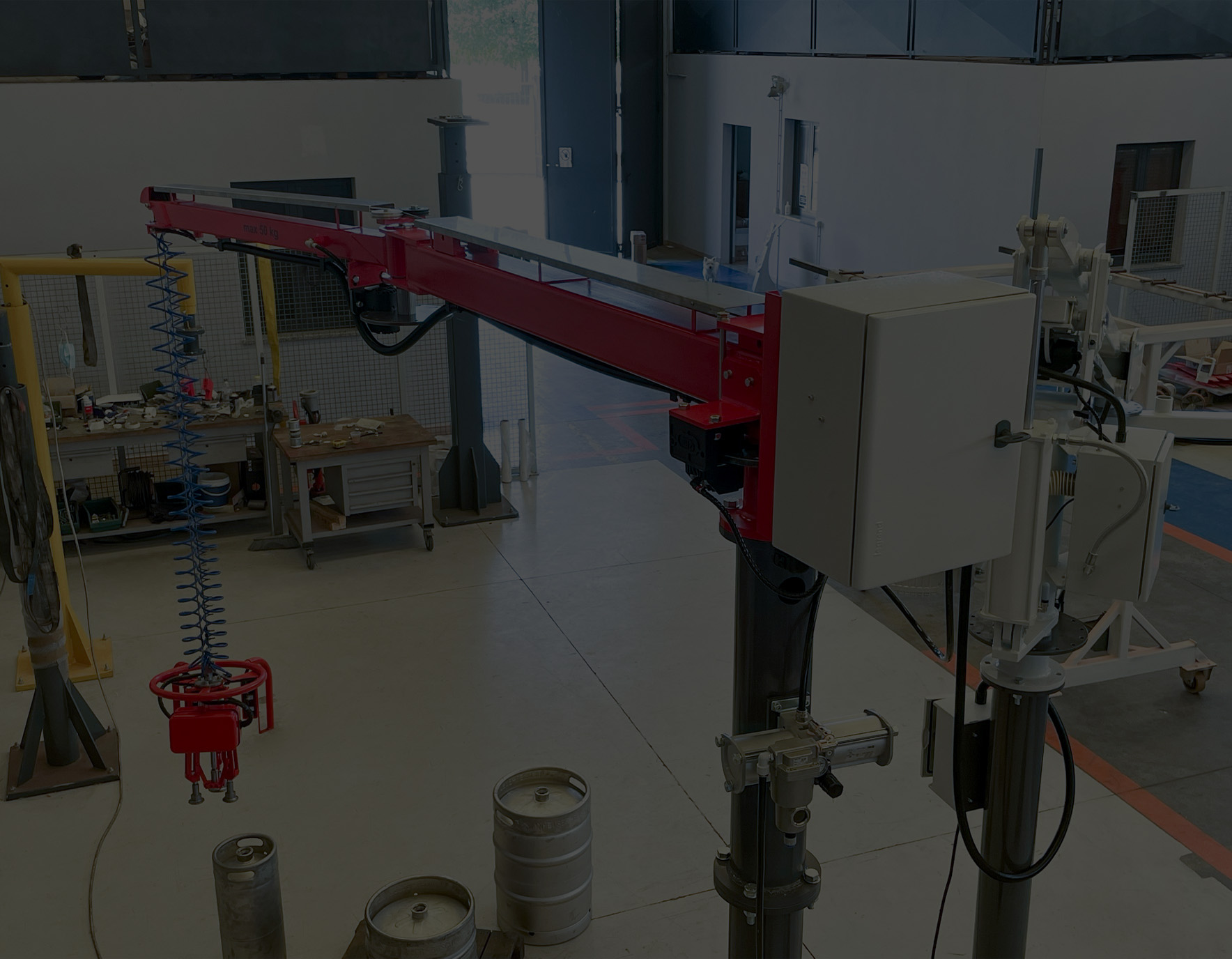
Industrial manipulators
There are many different types of industrial manipulators, each of which is designed to perform specific tasks in various industries.
Given the drive, we can distinguish the manipulators:
- air,
- Electronic.
Manipulators are also distinguished by their way of lifting, having the choice:
- vacuum lift,
- link mechanism,
- Joint arms.
Manipulators they are also divided by type of construction and can be:
- mobile, connected to the system of suspended bogie on the track,
- on a column with an articulated arm,
- on a column with a rigid arm,
- suspended on a flange fixing from the top.
Pneumatic manipulators
Manipulators air is a type of device used to lift, move or manipulate objects in production and industrial processes. They use compressed air for their work, which is supplied by a pipe/snake and converted to power work movements such as lifting, lowering, moving, rotating and grasping objects. Very often they are used in places where no other device will be able to work.
Air manipulator construction
Air manipulators consist of a manipulator arm, which is usually connected to the pneumatic system. The arm can be equipped with various tools and tips that allow easy grasping of objects of different shapes and sizes.
Air engine
An element that produces the force needed to move the manipulator. The pneumatic engine works on the principle of air compression, which is transferred to the working cylinder.
Working cylinders
Elements that convert pneumatic energy to linear motion. Depending on the design of the manipulator, cylinders can be unilateral or bilateral.
Air valves
Elements that control the air flow in the manipulator. Air valves allow you to control the direction of motion, speed and force of the manipulator.
Tool Set
Elements that allow the manipulator to capture, move and rotate objects. The tool set can consist of various components such as gripping, support plate or suction hoses.
Manipulator work
The manipulator design allows the load to move in each direction, within the limits set by the beam arm. The height to which we raise the object will define the height of the pole.
Each weight requires adequate air pressure in the tank to compensate and balance it. This air pressure is adjusted by means of a pressure regulator placed on the device (the pressure regulator for compensation of the tool arm is located in the control box). Once the weight is balanced, a special pneumatic automatic relay detects the air pressure in the cylinder and tries to keep it steady. If we don’t move the product, it will be lifted in space.
When we exert some pressure on the product, up and down, the air pressure changes in the cylinder (because the product no longer has the original weight); and a special relay adds or removes compressed air to or from the tank. When we stop applying pressure, the relay will stop working and the product will rise again in space.
The pneumatic piston, which controls the movement of the load up and down, is controlled by a special automatic relay valve and balances the weight of the product. The operator initiates the movement to lift or lower after balance so that it can hold the product anywhere and lead it exactly to the desired position/ place.
When the product is probably captured in the grip (and the choice is huge) and the balance is activated, the weight of the load is virtually imperceptible and the transported element is carried like a “balloon” in space.
This effect allows for quick and accurate movement of the product using natural manual operator handling due to the virtually undetectable weight of the product.
Manipulators have two special pneumatic circuits for the systems: one circuit balances the weight of the arm and tools; the other balances the weight of the shoulder, tool and product.
When we have to keep the charge out of the middle or when we need to make a tilt and/or turn, we usually use a manipulator with a rigid arm. This arm can be placed on a column on the floor, hung on the flange fixing from above or connected to the system of suspended trolley on a simple track to move the manipulator on a large surface
Key technical parameters
The selection of industrial manipulators requires taking into account many factors, such as the weight of materials that will be transferred, the distance to which they will be moved, the speed and accuracy of movement and the environmental conditions in which they will work. Therefore, it is so important to know which technical parameters to pay attention to first.
Key technical parameters of pneumatic manipulators:
Load capacity
The maximum mass the manipulator can lift. The manipulator capacity depends on its size, structure and compressed air force.
Scope of movement
The maximum range of the manipulator, i.e. the maximum distance at which it can reach and the maximum height to which it can lift the object.
Move speed
The speed with which the manipulator performs work movements such as lifting, lowering, moving or rotating.
Diameter of pneumatic cables
The diameter of the cables through which the manipulator takes compressed air.
Working pressure
Compressed air pressure required for proper operation of the manipulator. This value depends on the design of the manipulator and is specified by the manufacturer.
Weight
The mass of the manipulator itself, which affects its stability and durability.
Degree of protection
It is a class of manipulator protection against external factors such as moisture, dust, dust or shocks. This value is determined by the manufacturer and expressed in IP.
Control type
Air actuators can be operated manually or by means of control systems, such as radio pilots or programmable PLCs.
Use of pneumatic manipulators
Manipulators are used in every industry. They are dedicated to the automotive, welding and metallurgical industries. They are available in the food, chemical and pharmaceutical sectors. They are also very often found in glass, ceramic, rubber, wood, furniture and paper industries. Virtually any production hall or warehouse can use industrial pneumatic manipulators at work.
Carrying heavy items
Air manipulators are often used to move heavy objects such as steel sheets, concrete elements, pallets with products etc.
Packaging and palletisation
Pneumatic manipulators can help pack and transfer products to pallets.
Cutting and machining
Air manipulators are used to cut and process materials such as plates, sheets or tubes.
Installation
Air manipulators help in assembling various parts and components, including cars, machines and devices.
Transport of materials
Pneumatic manipulators are used to move materials from one production line to another, as well as to transport materials between different parts of the industrial plant.
Working in dangerous environments
Air actuators are used in places where safe manual lifting of heavy objects is impossible or dangerous, such as in the chemical and energy industries.
Operation of machinery and equipment
Air manipulators are often used to operate machines and equipment such as drilling machines, lathes, milling machines and welding machines.
Benefits of working with industrial manipulators
The pneumatic industrial manipulators are primarily:
- no electrical cables,
- no risks to the operator,
- Resistance to explosive chemical or other hazardous environments.
Universality
Due to its wide range of possibilities, well designed and tailored companies will provide safe, easy, ergonomic work regardless of the industry.
Low price
Industrial pneumatic manipulators are often cheaper than industrial robots or other mechanical devices, meaning they are more accessible to smaller businesses.
Simple design
These devices have a simple design, which means they are easy to use and maintenance.
Security
Since there are no electrical elements in them, the risk of electrocution is eliminated.
The availability of compressed air
Compressed air is available in most industrial plants, meaning that pneumatic industrial manipulators can be easily integrated into existing systems.
Is the operator’s work safe?
Every physical work involves a certain type of threat. An operator can be affected by noise at the factory or bad lighting. On the other hand, if it works outside, it can be unpleasant to change atmospheric conditions. The risk also involves excessive physical effort, or spending many hours in one position. The greatest danger is to be crushed by heavy loads. However, if we follow the principles of health and safety, such work will not pose any threat to us.