
Column crane vs. crane: Strategic choice in logistics inside the hall

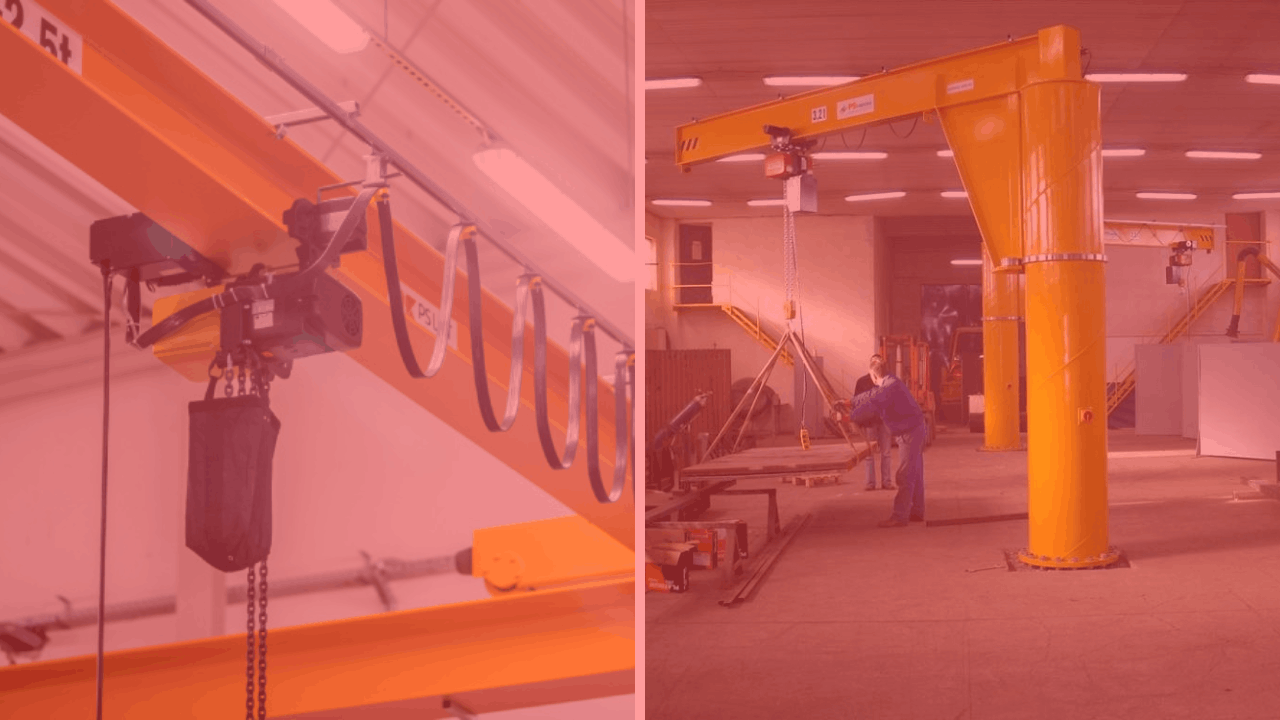
In the industrial sector, the decision to choose a crane system is more than a matter of “weight lifting”. It’s a decision to process capacity. . . The choice between the crane and the pole crane determines whether your hall will work in continuous rhythm, or it will become a hostage of the “rail to hook”.
Positional Ergonomics as a Hidden Profit Factor
In a modern plant, with rising labour costs, the key indicator is production tact.
- Bridge crane: It’s a long-distance transport service. Its recall, passage through the hall and setting over the detail takes an average of 3–8 minutes. With 20 surgeries a day, it’s close. 2 hours downtime highly qualified employee (e.g. CNC operator).
- Workshop crane: It is available “right away”. Reduces the time of auxiliary operations by approx. 70%. . . Thanks to the bearing joints and optional electrical rotation, fatigue of the operator is minimized, which directly reduces the number of mounting errors.
Technical and economic analysis: Where is the limit of profitability?
When selecting a device it is worth considering parameters that often elude in the first stage of costing: Structural rigidity and precision (CNC & Tooling) When placing heavy injection moulds, the rigidity of the system is crucial. The cranes have a larger bowing arrow of the girder at maximum spans, making it difficult to position millimeter. PS Lift pole cranes have a shorter arm (usually 6–8 m), which provides extreme vertical stability of the load. It’s critical to work with expensive plates. ‘Dead zones’ under the crane Overhead cranes have inaccessible areas near the end carriages and walls. With the option of 360° rotation, a pillar jib crane can handle parts immediately next to the structural column, improving the use of warehouse space by 15–20% within the nest.
Engineering aspects: Installation and construction requirements
For the B2B client, adaptation of the hall is a key cost hidden.
- Foundation: An overhead crane requires a supporting runway structure. If the hall has no suitable brackets, constructing the crane support structure may double the investment cost. A pillar jib crane (up to 1000 kg) can often be installed directly on a reinforced floor using dynamic base plates (chemical anchoring), without earthwork.
- Upgrading (Retrofitting): The cranes are mobile. In case of relocation of production, dismantling and reassembly takes 1-2 days. The overhead crane is usually an “on stiff” investment related to the building.
Security and UDT – what do you need to know in 2026?
Both devices are subject to technical supervision, but the operating costs vary significantly:
- Maintenance: The crane review is less invasive. It does not require basket lifts to check the track at heights, which reduces the costs of periodic service by approx. 40%.
- Resurs: Monitoring the rate of wear (resurs) in one position is easier to predict, making it easier to plan renovation budgets.
Comparison of solutions in business scenarios
| Business scenario | Recommended solution | Main reasons |
|---|---|---|
| Mounting line (details to 2t) | Column crane | Independence of positions, no ‘railways’. |
| High storage warehouse | Track crane | High load capacity and a lot of room for manoeuvre. |
| CNC Machine Powering | Wall crane | High rigidity, no ‘rolling’ charge. |
| Hired hall | Crane on the foundation plate | Easy dismantling and transferability. |
Summary: Invest in liquidity, not just in lifting capacity Instead of buying a second, expensive crane, consider retrofitting the hall with 3–4 pole cranes. This configuration will allow:
- Disposal of bottlenecks in production.
- Increase safety (limitation of transport over the heads).
- Real savings thanks to higher productivity of employees.
Does your hall need an audit of the efficiency of close transport? Contact the team PS Lift. . . We will analyze your technological system and choose the solution that will be the fastest to earn.
FAQ (Most Frequently Asked Questions)
- Does mounting a pole crane always require pouring a new foundation? Not always. In the case of cranes with a lower load capacity (usually up to 500-1000 kg) and an appropriate thickness of the existing floor, we use special dynamic plates and chemical anchoring. This allows installation of the device without the need for costly and time-consuming earthwork.
- What are the main differences in UDT servicing costs between an overhead crane and a jib crane? The service of the pole crane is usually about approx. 40% cheaper. This is due to easier access to the mechanisms (no use of basket lifters for high-height track inspection) and easier construction of the road system.
- Can a pole crane replace a crane in the production hall? The crane will not replace the crane in long-distance transport (for the entire length of the hall), but is an ideal solution for handling specific production outlets (e.g. CNC stations, assembly lines). The most efficient plants use hybrid system: crane for general logistics and cranes for precision work.
- What is the resurs of the device and how does it affect the choice of crane? Resurs is a designed time of safe operation of the device. In the case of stand cranes where the work cycles are repetitive and easy to estimate, monitoring of the degree of wear of the structure is simpler. This allows precise planning of modernization and avoids sudden downtime in production.
- After changing the layout of the hall, can I move a column crane to another place? Yes, it is one of the biggest advantages of PS Lift cranes. Unlike cranes that are permanently linked to the building’s construction, the pole crane can be dismantled and installed in a new location within 1-2 working days, making it a mobile and flexible investment.