Electric cranes Flex Lifting: mobile lifting to 2,000 kg without compromise

When a problem arises in the production hall or warehouse with the safe movement of heavy loads, the first associations are a crane or a permanent manipulator. Meanwhile, more and more companies discover a simpler and much more flexible solution: mobile electric crane with counterweight. A device that does not require costly infrastructure is ready to work immediately after delivery and gives freedom which the crane will never provide. As an authorized distributor of Flex Lifting in Poland, PS-Lift offers a full range of electric cranes of this Italian manufacturer – from compact 200 kg models to solid 1,000 kg units, to heavy load capacity versions of 2,000 kg. In this article, we will show why it is worth considering electric cranes, how to choose the right model and what benefits this solution brings in practice.
What is an electric crane with counterweight, and why does it displace classic solutions?
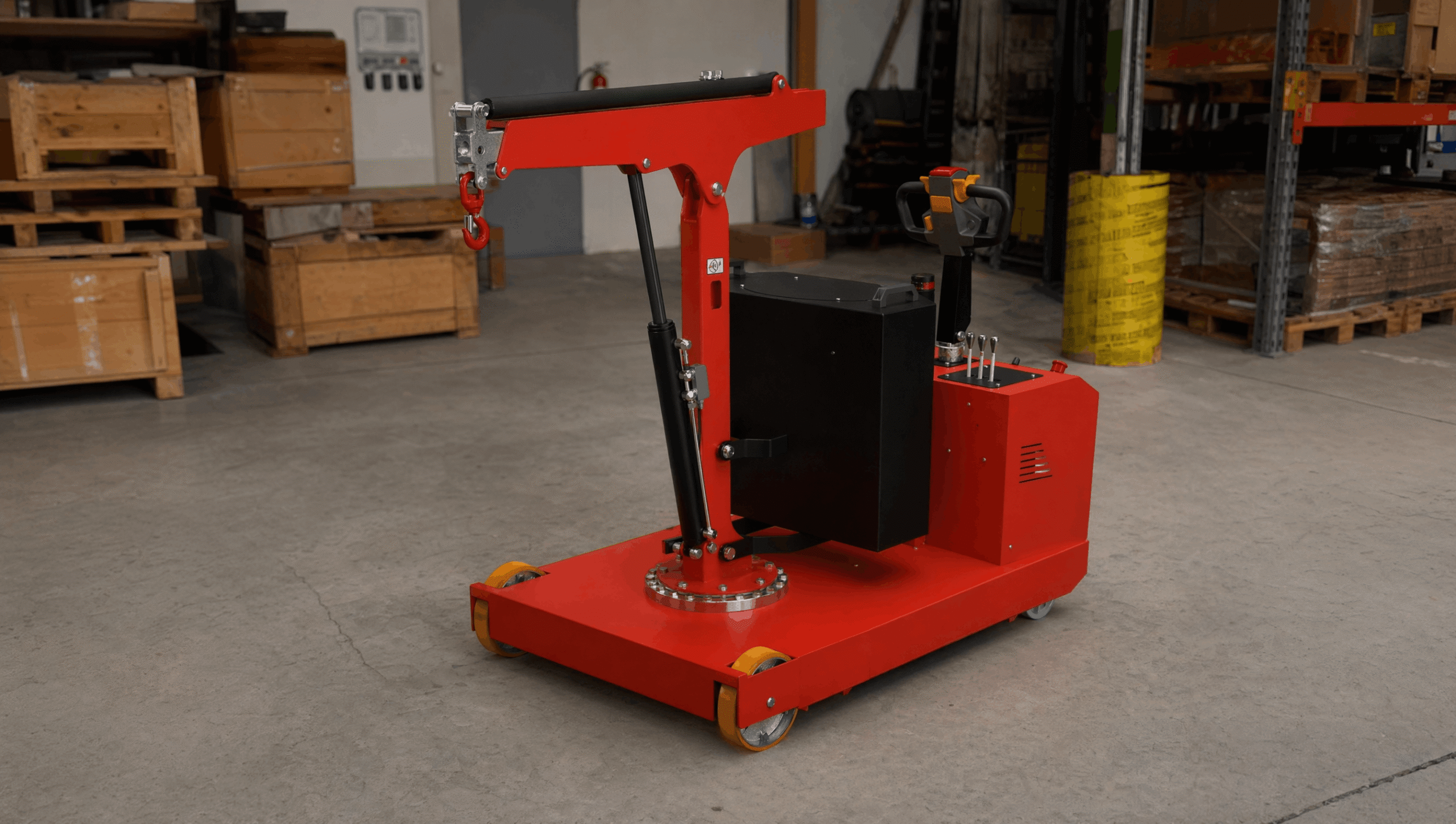
An electric crane with counterweight is a self-propelled crane device in which the weight system on the opposite side of the arm ensures stability without the need for anchoring to the floor or building structure. The electric drive supports all work movements: lifting and lowering the load, pulling and sliding the arm – and depending on the model also rotation of the arm and driving of the device. The traditional crane requires load beams, running track and UDT reception after installation. The fixed manipulator supports only one pre-defined working point. The electric crane is free of both these restrictions: it can be moved to another site of the hall within a few minutes, used temporarily at another production line or taken to the construction site.
| Why is mobile electric crane winning with alternatives? |
| There is no cost of installation and reception by UDT (like crane) |
| Freedom of movement throughout the establishment |
| Ready to work without a construction project |
| – Lower purchase costs with comparable load capacity |
| The possibility of co-financing the Social Security Office for improving working conditions |
Flex Lifting – Italian precision and 30 years of experience in mobile cranes
Flex Lifting (AXA Group, Bologna) is a manufacturer with more than thirty years of experience in designing and producing mobile counterbalanced cranes. All manufacturing takes place at its Italian plant, supporting consistent quality control, strict compliance with European standards and a short response time for special orders. Flex Lifting products go to distributors in several countries – in Poland the sole partner is PS-Lift. . . This means access to original spare parts, technical support in Polish and service provided by certified technicians. Each model meets the requirements of Machinery Directive 2006/42/EC, has a CE marking and passed load tests in accordance with EN 13157 and EN 14238.
Overview of models of Flex Lifting electric cranes
The Flex Lifting electric line includes several variants, differing in load capacity, arm length, boom configuration and type of control. Each model is available in a version with lever control (Suffix L) or radio (Suffix R).
Parameter table – quick comparison
| Model | Load capacity | Max. span | Control |
| ORBIT 200EL/ER | 200 kg | 2 050 mm | lever / radio |
| FLEX G500SBL/SBR | 500 kg | 1 930 mm | lever / radio |
| FLEX G750DBL/DBR | 750 kg | 2 400 mm | lever / radio |
| FLEX G1000DBL/DBR | 1 000 kg | 2 400 mm | lever / radio |
| FLEX F1000DBL/DBR | 1 000 kg | 2 500 mm | lever / radio |
| ATLAS 1TE3L/3R | 1 000 kg | 3 161 mm | lever / radio |
| OMNIA 2TL/2TR | 2 000 kg | 3 067 mm | lever / radio |
The maximum lifting height exceeds 5 400 mm in the largest OMNIA 2TL model, making it one of the most versatile mobile cranes available on the European market.
Key models characteristics
ORBIT 200EL / 200ER – compact master of maneuverability
The ORBIT 200 is designed for companies needing a lightweight, manoeuvrable crane for narrow aisles, assembly lines or service workshops. Its 200 kg capacity and 2 050 mm reach cover most tasks in the automotive, electronics and small-scale manufacturing sectors. The 210° jib rotation allows flexible load positioning without moving the entire unit.
FLEX G500SBL / G500SBR – half-tonne crane with 270° rotation
The heart of the G500 series is a rotating arm performing full 270° – rare in this load class. This allows one crane to handle both the loading page and the destination location of the folding detail without changing the position of the device. The maximum span of 1 930 mm and the lifting height of 2 737 mm make the G500 ideal for service, workshop and production sockets.
FLEX G750DBL / G750DBR – gold middle load medium
The G750 series is one of the most popular choices in the Flex Lifting portfolio. The load capacity of 750 kg, the range of 2 400 mm and the height of 3 938 mm are parameters that meet most industrial requirements. Electrical lifting with two proportional speeds allows the operator to accurately control movement even with delicate components.
FLEX G1000 and F1000 – one thousand kilograms with two jib versions
The G1000 series has a rotating jib (220°), ideal for work along an arc. The F1000 series uses a fixed jib with a double electric extension, well suited to work along a single axis, for example at conveyor belts or loading ramps. A maximum reach of 2 500 mm and a lifting height of almost 3 900 mm allow most production workstations to be served without changing the layout.
ATLAS 1TE3L / ATLAS 1TE3R – triple electric boom, maximum range
ATLAS stands out triple, fully electric boom reaching a range of 3 161 mm – the longest in the class of one tonne. This is an ideal solution for companies that have to operate deep-seated machines, containers or multilevel racks. The maximum lifting height of more than 4 600 mm opens applications not available for standard cranes with one or two boom segments.
OMNIA 2TL / OMNIA 2TR – two thousand kilograms in a mobile design
At the top of the electric line stands OMIA 2T – a device with a load capacity 2 000 kg and a range of over 3,000 mm. The lifting height exceeding 5 400 mm allows assembly work with large-size machines, operation of antresol and installation of equipment on storeys. Despite impressive parameters, OMIA 2T remains a mobile device, ready to be moved to another site of the plant without any interference with infrastructure.
Leverage control vs. radio – which one to choose?
Both control variants support the same range of motions: lifting/ lowering, pulling/removing of the arm and driving of the device. The difference lies in the operator interface and resulting ergonomics of operation.
Leverage Control (Suffix L)
- The operator works directly on the device, handling the levers mounted on the column.
- The solution preferred in environments where constant contact with the machine is a standard procedure.
- Lower purchase cost, no chargeable items.
- Ideal in service, workshop and series production at fixed stations.
Radio control (Suffix R)
- The operator may be within a distance of several metres of the device, observing the suspended charge from the optimal angle.
- Clearly improved safety at work with irregular loads or in limited space.
- Recommended when installing machinery, loading vehicles and wherever the visibility from the operator’s position at the column is insufficient.
- The remote control shall be equipped with emergency stop function and signal range control.
Where do electric cranes work best?
The mobile nature of an electric crane with counterweight makes it possible for one device to perform many functions in the same plant – depending on current operational needs.
Production and assembly
At the assembly lines, the crane takes over the tasks of hand handling heavy components – engines, gearboxes, injection moulds, tanks. Proportional speed control allows you to precisely set the detail to a millimeter, which eliminates damage and reduces installation time.
Internal storage and logistics
In the warehouse, the electric crane complements the forklift and pallet trucks wherever the dimensions of the goods exclude standard equipment. Especially useful for loading and unloading vehicles, working with antresols and handling high-bay racks.
Service and maintenance
For the UR department, electric crane is an invaluable support for replacement of machine components: electric motors, shafts, gears, hydraulic pumps. The possibility to enter any place of the hall without disassembly of other equipment is a huge advantage over fixed crane solutions.
Construction and installation of installations
Models with a large range (ATLAS, OMANIA) are used on construction sites when installing prefabricated components, air conditioning equipment and industrial installations. Electric drive means zero exhaust emissions – the device works safely in both open space and indoors.
Work safety and standards – what does Flex Lifting guarantee?
Each Flex Lifting electric crane undergoes load tests with a coefficient of 1.25 nominal lifting capacity before leaving the factory. Devices shall have:
- CE certificate in accordance with Machinery Directive 2006/42/EC
- Compliance with EN 13157 (handlifts) and EN 14238 (manufacturing cranes)
- Electronic load limiter to prevent overload
- Electromagnetic brake stopping charge at power loss
- Robust wheels with parking block on each stabilizing leg
- Clear lifting boards and safety instructions in Polish
The introduction of electric crane to the workplace reduces the risk of accidents associated with manual lifting of heavy loads – one of the main causes of muscle-skeletal system injuries in the Polish industry. Moreover, the purchase can be co-financed by ZUS as part of a programme to improve working conditions.
Co-financing ZUS – electric crane can cost you less than you think
PS-Lift has been supporting customers for years in obtaining ZUS funding for the purchase of crane equipment improving work safety. An electric crane qualifies as a means to prevent spinal injuries and accidents at work, making it one of the the most financed equipment in ZUS competitions. The funding may cover up to 80% of the investment value (for small companies) or up to 50% (for large enterprises). Our sales department will assess whether your application has a chance of accepting and will help in the preparation of documentation.
PS-Lift offer: more than delivery of the device
As a distributor of Flex Lifting with many years of experience in the crane industry, PS-Lift offers comprehensive service for the purchase and operation of electric crane:
- Model selection based on analysis of the needs and conditions of the hall
- Demonstration of operation of the device before purchase
- Delivery throughout Poland
- Training of OSH operators and employees
- Guarantee and post-guarantee service by certified technicians
- Access to original Flex Lifting spare parts
- Support for ZUS co-financing applications
Our offer includes not only electric cranes. In the PS-Lift catalog you will find a full spectrum of cranes – chain hoists, cranes, scissor lifts, vacuum suspensions and many more – which allows to fully equip each workstation.
Related products and categories in the PS-Lift offer
If the electric crane fits into your needs, check also related categories in our store: → Counterbalanced workshop cranes – full category, including manual and electric models → Jib cranes – all types of cranes in one place → Workshop cranes – lighter solutions for workshop and service → Overhead cranes – permanent systems for large industrial halls → Industrial manipulators – precise installation support → ZUS co-financing – check how to finance the purchase of the device → PS-Lift Blog – knowledge and advice for the crane industry
FAQ – the most common questions about electric cranes
Does an electric crane require registration in UDT?
Lifting equipment with a load capacity of up to 250 kg and a driving speed of up to 0,1 m/s shall, in principle, be exempted from the registration obligation. Models with a higher load capacity need to be notified to the Technical Supervision Authority. Our technical department will help you determine what formal responsibilities are associated with a specific model.
How often should an electric crane be operated?
The manufacturer of Flex Lifting recommends reviews every 6 or 12 months, depending on the intensity of use. PS-Lift performs inspections and maintenance throughout Poland, and our technicians have UDT privileges.
Can an electric crane be used outside?
Yes, subject to caution with strong winds and avoiding operation during precipitation without adequate protection of the electrical system. The Flex Lifting models have a degree of IP protection suitable for working in typical industrial conditions.
How much does an electric crane weigh?
The own mass depends on the model. The compact ORBIT 200 weigh about 800 kg, while OMANIA 2T – more than 1 900 kg. Nevertheless, all devices are mobile and can be moved manually or via a logistics tractor.
What’s the delivery time?
For models available in stock, delivery time is usually a few working days. In case of special or large order configurations, please contact our sales department to set a deadline.
Summary – an electric crane that fits your needs
Flex Lifting electric cranes are thoughtful, sophisticated devices manufactured for intensive industrial use. The wide range of lifting capacity (200–2,000 kg), two control options and several boom configurations make each company find a model tailored to its requirements in the Flex Lifting line. As a distributor with many years of experience, PS-Lift guarantees not only the delivery of equipment, but comprehensive support – from model selection to operator training, service and assistance in obtaining ZUS funding.
Do you have a question? Call or write – we would be happy to advise you. 📞 +48 65 513 12 92 | ✉ sekretariat@ps-lift.com → Go to the contact form