
Suspended overhead cranes — key information


The cranes are an integral part of industry and logistics, allowing efficient transport and lifting of heavy loads. The choice of the right type of crane can significantly affect the efficiency of production and warehouse processes.
Lift cranes is a very well-known solution in the field of internal transport and heavy cargo lifting. Such cranes will be particularly effective if it is possible to hang up to the ceiling or roof structure.
The use of suspended cranes with a steel bridge beam is the best solution when the hall is a low room. When there is no room for standard trackways under the overhead cranes, they are an excellent alternative, and more affordable.
But the cranes are not only mounted to the existing building. They can also be installed with support structure, anchored to the floor. What distinguishes them from the track crane is the fact that the bridge hangs up to the lower part of the tracks, and the dead zones (i.e. where the hook of the hoist does not reach) are reduced to a minimum.
Suspended cranes may also be light overhead crane systems i.e. aluminium, steel or double beam profiles.
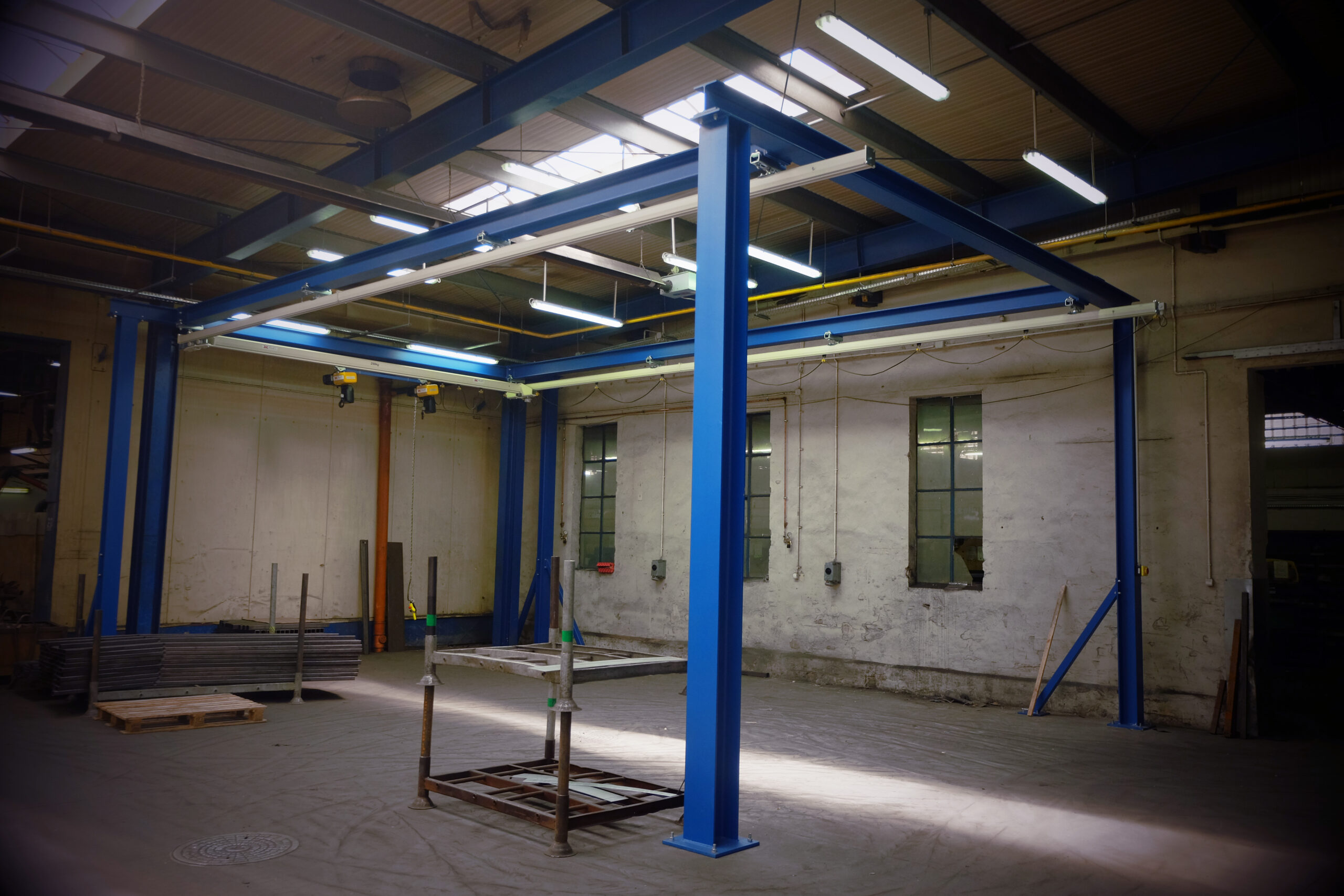

Presented cranes allow the cargo to move freely around the production hall or warehouse. This allows you to operate different workstations more efficiently, depending on how large the area of the hall a given crane is intended to cover. Lifting equipment of this type ensures precision and control of the load, which is extremely important in the case of work requiring accuracy. Each crane is designed for the safety of users and carried by cargo operators.
Since suspended cranes occupy a minimum space, this allows optimal use of available space in the production hall. You can also use a chain hoist for low build to completely minimize loss of space.
Speaking of hoists, the cranes have lifting units that allow the operator to transport the cargo. What the device will be used is of great importance, especially in cases of unusual implementation.
The choice is electric and hand chain hoists, rope hoists and pneumatic hoists for specialized work zones. For repetitive operations with lower weights, vacuum lifts are most often used for the manipulation of sheet vacuum suspensions. If the hoists are chosen, additional fittings that often allow to attach large or very bulky loads are also traverters, magnets, balancers and generally special-purpose slings.

Before we start.
When choosing suspended cranes, there are some important issues that should be considered before making a purchasing decision.
Licences
All cranes are subject to the Technical Supervision Authority. However, not all have to be reported – cranes with a load capacity of up to 250 kg are not subject to notification, whether they are equipped with hand or electric chain hoist.
Permissions
In order to become a crane operator, you must complete the course on the operator and pass an examination certified by the Technical Inspection Office. Such allowances shall be valid for five years, three months before the expiry of the time limit, an application for renewal of entitlements shall be submitted.
Parameters
Of course, when going to a good crane manufacturer, specialists help from the beginning of the project when it is necessary to specify all parameters of the crane. However, it is worth considering what conditions prevail in the place where the crane device will be used, whether there are factors such as moisture, low or high temperature and the presence of chemicals. This will also affect the choice of the right model of the crane.
It is necessary to determine in advance how many and what loads will be raised. The load of the crane will be the most important parameter of the crane – in PS Lift cranes up to 10 tonnes are produced.
Another important aspect is the length of the beam or the dimensions of the structure. In PS Lift, detailed measurements are often made already at the valuation stage, but in order to estimate the size of the project it is also worth thinking about. Please note that the beam must be long enough to handle the area to be covered with a crane.
Another important issue will be the speed of the crane and access to control. The cranes can be manually controlled by means of a control tape or remotely and by automatic systems. A specialist should come back here with help.
It is also worth to ask a specialist what is the difference between the c-rail and the tube, and when we use which solution. An experienced engineer will immediately answer these questions.
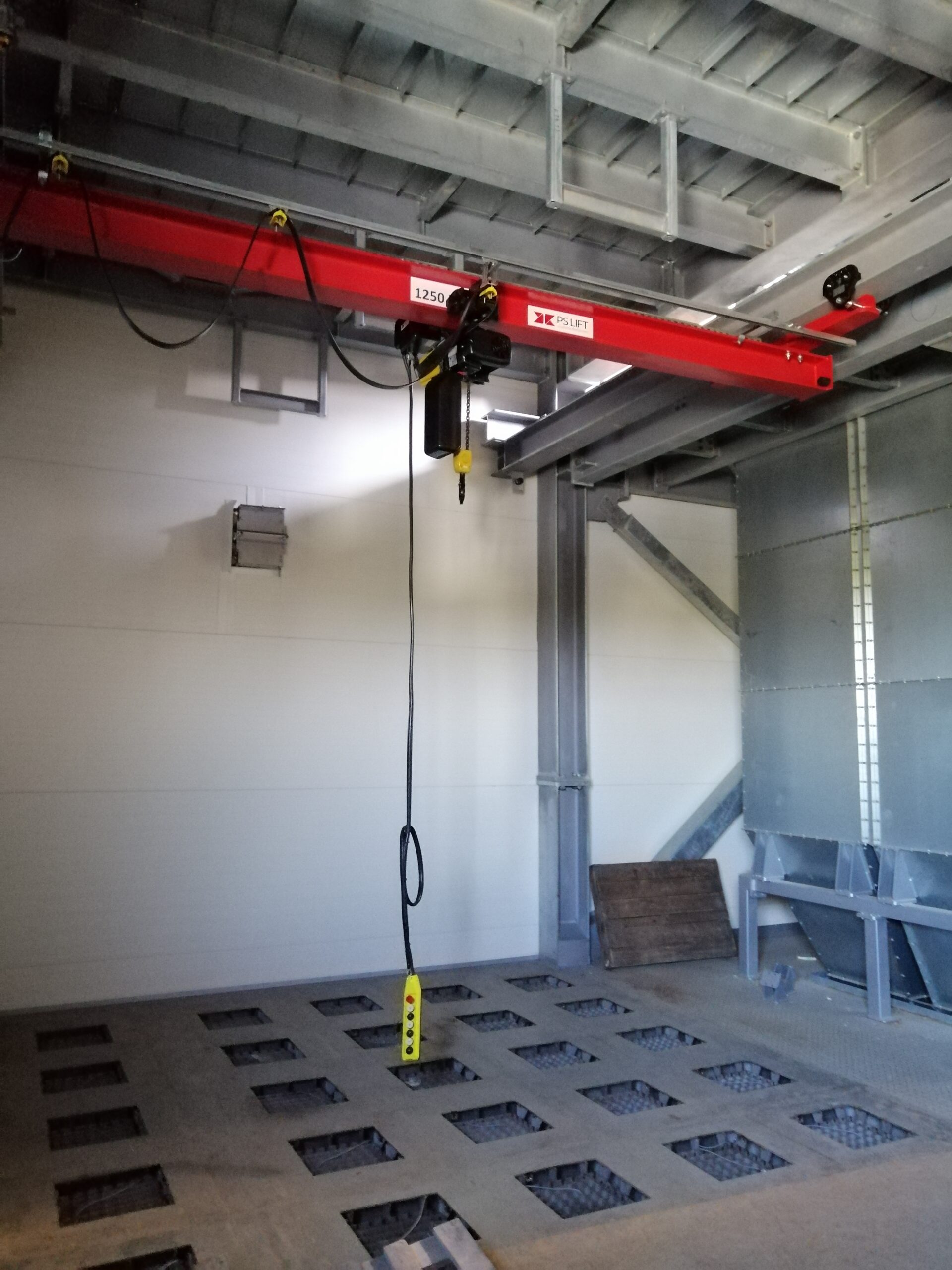
After-sales care, assembly, maintenance, UDT reception reviews

The crane is mounted, but what’s next… It is very important to work with the service department of the company, which will not only install the crane, but will also carry out regular technical inspections, maintenance and service. It must be taken into account that care for the crane is crucial to its durability and safety.
PS Lift Service Department provides comprehensive support for crane equipment. This is very important and not so common at all.
The offer includes installation, warranty and post-guarantee reviews, or even readiness in 48 hours in case of failure.
The staff of the department are also reminded of technical reviews and they deal with all the “paper” work.
What’s important, they’re helping the crane be picked up by a UDT inspector. PS Lift cranes are maintained even on the day of reception.
In conclusion, suspended cranes are a key element of industry and logistics, allowing efficient transport and lifting of heavy loads. The choice of the right type of crane depends on many factors, such as assembly site, load, environmental conditions and user’s needs. Before purchasing a crane, it is worth consulting an experienced specialist who will help to adjust the solution to specific needs. It is worth investing in properly adapted suspended cranes to optimize production and storage processes and ensure the safety of workers. These cranes, thanks to their versatility and effectiveness, are an indispensable tool in today’s industry and logistics.
