
Titan clash – crane vs crane


In the previous articles, we mentioned cranes and cranes. . . We described their characteristics, the design, what kind of permissions you have to have when you have to report the device to the Surveillance Office. Such a knowledge compendium is still available on our blog.
As a manufacturer of the lifting equipment mentioned above, we receive many enquiries about overhead cranes and jib cranes. Almost everyone looking to improve internal material handling considers these solutions.
In small, medium-sized and large companies, in halls, warehouses and production plants, overhead cranes and jib cranes are suitable for material handling almost everywhere. Customers do not always know which of the two will better meet their needs. That is where we can help!
Construction differences
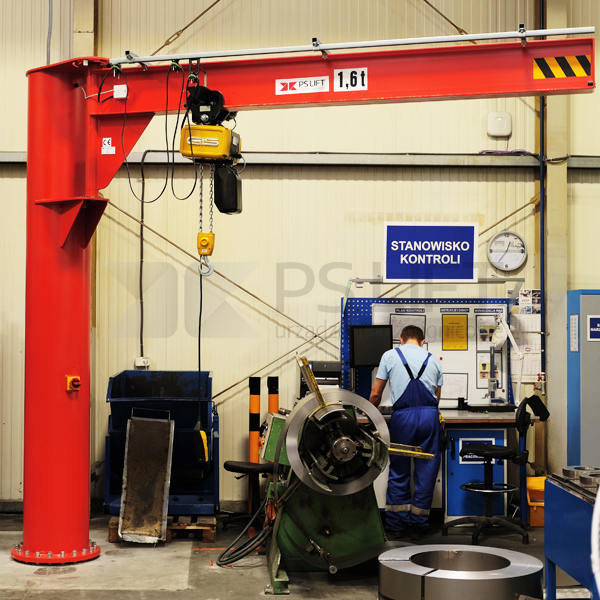
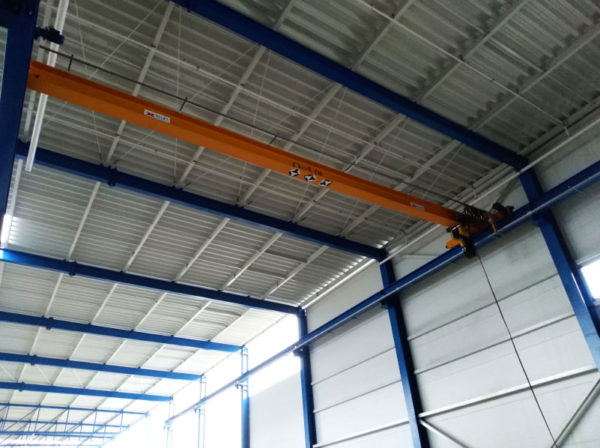
The crane and stationary crane differ significantly from each other in construction. The construction of the crane is less complicated and usually takes up much less space. The crane structure consists of a pole (column) and/ or the arm itself (upper), which performs rotational motion. The structure of the crane consists of a supporting part – that is, a bridge that moves on the tracks and a lifting unit on the trolley on the bridge. The track – part of a fixed crane – is usually mounted on a steel supporting structure or building structure.
In terms of their construction, the only elements these types of lifting equipment have in common are the lifting units that can be suspended from their structures. For example, a manual or electric chain hoist, a vacuum tube lifter or a vacuum lifting attachment can be used with either an overhead crane or a jib crane. The choice of suspended device depends entirely on the task.
In the case of a crane, the added value is that we can work with suspended lifting beams, which we hang on one or two hoists. Lifting beams longer than 2 meters will not be a good solution for stationary cranes – it is no different in the case of rotors – here again the crane takes the advantage.
Another discrepancy between the crane and the stationary crane to be taken into account is the different assembly of the presented cranes.
Given the mounting of the crane, its design is usually mounted on one pole, or it is attached to a wall. Depending on the room in which the crane will work, it can be mounted in a foundation or on a dynamic plate on the floor.
As for the crane, this can either be fitted to an existing hall structure or support structure, or on pre-prepared brackets. If we have the possibility, we can also lift the crane to the ceiling.
You often ask us: Then where better to mount a crane, and where’s the crane?
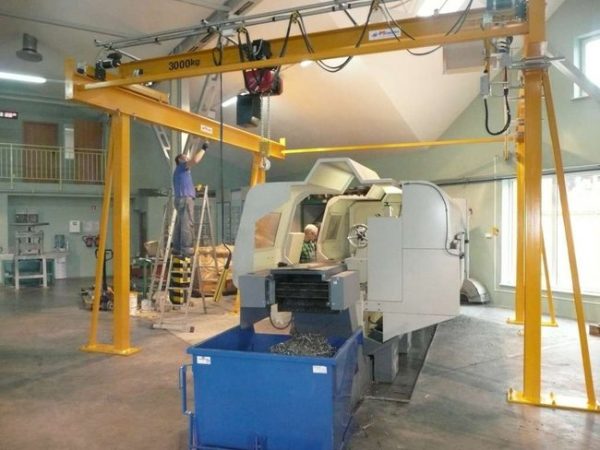
– In rooms with a smaller surface and height it is much more advantageous to put a stationary crane, which we can even attach to the machine. This is also a much better proposal for those who need to serve their jobs in a limited capacity.
In the case of a crane, we need to develop a larger working area. Of course, larger sizes allow even more bridges to be installed and thus hoists, and this in turn will translate into a simultaneous possibility to operate many workstations. There are many options, therefore it is better to use the help of a specialist who knows exactly the capabilities of individual devices. – Answers Jarosław Juskowiak, Sales Engineer at PS Lift, is an experienced specialist in overhead cranes and jib cranes.
How do jib cranes and overhead cranes work?
We now know how overhead cranes and jib cranes are constructed, and we have covered the basics of installation. But how do these lifting devices work?
In both cases, the load is moved in three planes.
The working area of the crane is similar to that of a roller. The range of motion around the pole axis may be 360 degrees or be freely limited. The crane will work perfectly as a device for inserting details into the machine, replacing materials used in the production process, forms, cut-outs, sheet feeding on cutting machines, burners, and repair work as a lifting machine. The pole crane can also be adapted for outdoor work. In combination with a vacuum lift it will be great for carrying cartons, furniture boards, glass, sheet metal, bags. This will be the ideal solution for chemical, pharmaceutical, food, furniture, paper or construction and production industries.
The cranes, on the other hand, support a space close to the rectangle. As we have already mentioned, the crane’s work area is much larger than the crane’s work area. The range of movements is limited by the length of the track and the span of the bridge. If there is a need for a crane, we can cover almost the entire area of the hall and hang even several bridges on the track. The crane will work perfectly in the industrial industry, where heavy loads should be raised, in production halls or in warehouses, as well as in handling and logistics and automotive industries. Suffers are also often used in the furniture or food industry, where multiple workstations are required.
Permissions, security, health and safety
There are few differences here. Both overhead cranes and jib cranes are subject to technical supervision. In most cases, this is full technical supervision.
We do not have to report equipment to the Technical Surveillance Office if they are subject to simplified supervision. This happens in the following cases:
I – crane with a capacity of 250 kg,
II — 1000 kg crane with single-phase electric chain hoist,
III — A crane with a load capacity up to 250 kg
In order to operate the crane and/or crane, the operator must gain permission. It is worth noting that they do not entitle to carry out technical inspections, maintenance, service or assembly of cranes.
When occupational health and safety rules and all procedures applicable at the site are followed, operating an overhead crane or a jib crane is safe. Risks can arise if the employer neglects technical inspections or maintenance, or if operators misuse or overload the equipment.
Comprehensive operation
Before purchasing an overhead crane or a jib crane, we need to answer the following questions:
- What are we going to lift and how high?
- How much capacity does the device have to cope with, and what intensity will it be?
- With what accuracy do we want to work and where do we want to put the charge?
- Do we create a job for one or more people?
- What’s our budget?
The most important criteria for cranes are: lifting height, arm length, load capacity, maximum device height, information whether we want an electric or manual hoist, electric or manual trolley, rotation of the electric or manual arm, or whether we need e.g. a traverter, vacuum lift, or maybe chain slings.
In the case of a crane, the criteria are similar. It should be remembered here that instead of the length of the arm we are interested in the span of the bridge and the length of the track. In simplification, the product of these two values gives the working area of the crane. In addition, we can hang more than one hoist on the crane, and in the track it can drive as we mentioned earlier even several bridges.
Let’s point out that the greater possibilities at high altitudes are given by a crane. For example, the crane bridge can be suspended at high heights of 8-10 metres, while in the case of stationary cranes the limit is 5-6 meters overall height.
Given the costs we will have to bear, the crane is a more expensive solution. From construction to the price of assembly, maintenance or service. However, if we want to serve e.g. 3 workstations with one crane or alternatively buy 3 cranes may prove that this solution is not only better, but also cheaper.
As a manufacturer of crane equipment with many years of experience we invite you to contact us – we will help you choose the best solution.
Do you have any questions, doubts? We’re at your disposal!
