
Chain hoist: how to choose the load capacity, drive and version for working conditions

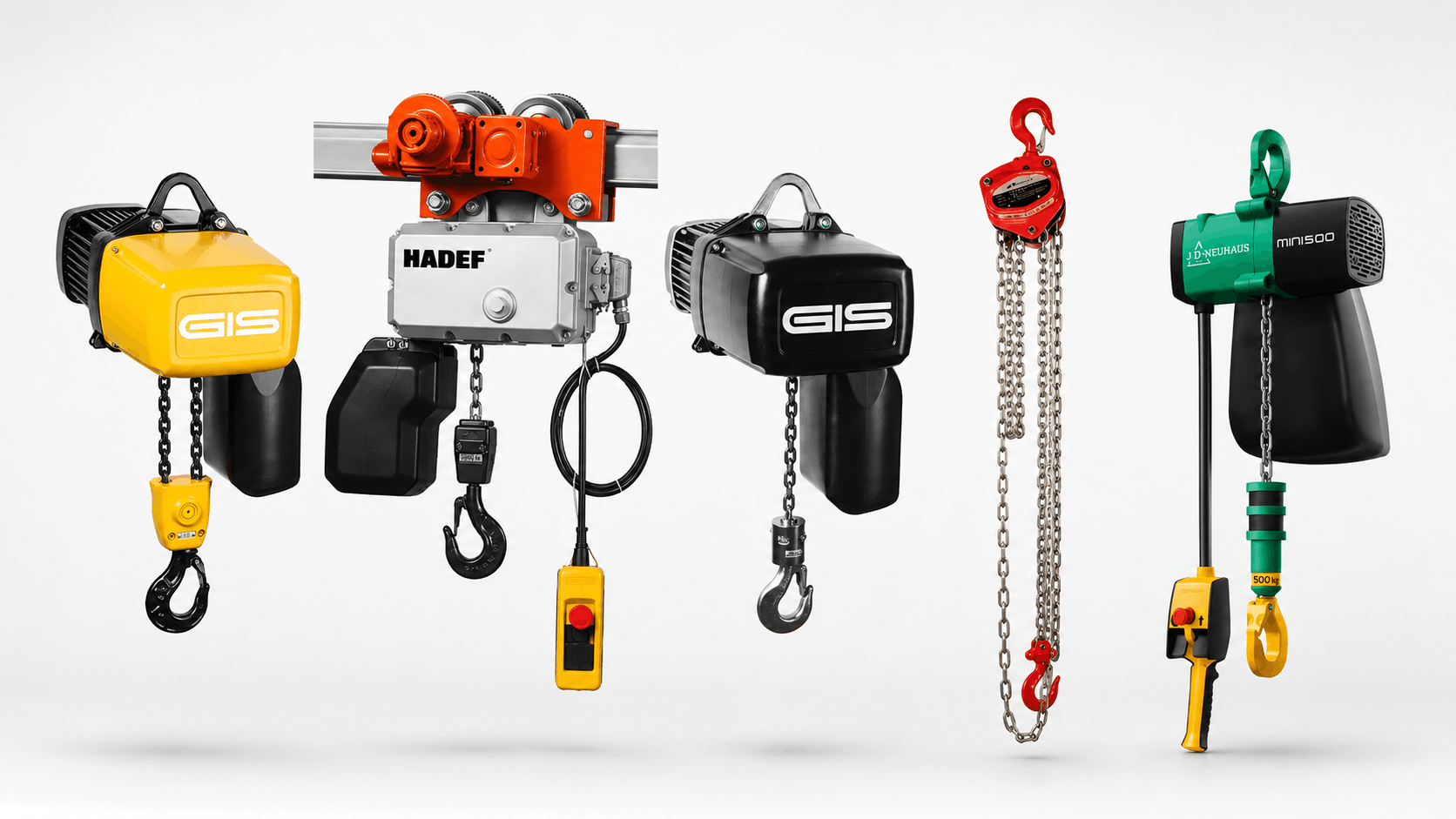
The chain hoist shall be selected according to four parameters: load capacity, lifting height, type of drive and working intensity group. A manual model of up to 2 tonnes is enough for a casual installation, an electric hoist is tested for repeated lifting in the hall and ATEX and anticorrosive versions are required in potentially explosive or humid zones. Below you will find specific criteria that allow you to order a device immediately tailored to the station, without costly mistakes.
What is a chain hoist and where it works
The chain hoist is a lifting mechanism in which the weight is borne by a chain-carriage chain. The device is an essential part of the equipment of cranes, gantry winches and stationary cranes, but it also often works on its own, suspended on a hook or a carriage. It is used in the manufacturing industry when moving components on the assembly line, in construction for lifting beams and prefabricates, in warehouses and in machinery workshops when replacing moulds, dies and machine tools. The heart of choice is always to ask what and how often you will lift. Another device will work for occasional installation, and others for continuous operation for several cycles per hour. In the PS Lift offer you will find a full cross-section of these solutions in category Chain hoists, from hand models to advanced electric drives.
Choose the load capacity of the chain hoist
The load capacity is the maximum mass that a device can safely lift, and this is the first parameter from which you start selection. The range is very wide, from 100 kg models to popular 1000 and 2000 kg variants, to hand constructions that carry up to 50 tonnes. Contrary to popular opinion, no device with a load capacity higher than that resulting from the real weight of the load is selected. Each hoist has a pre-built safety factor: the 1000 kg load model normally has a supply of 1500 kg, and in some designs the spare is even eight times. Buying an “expandable” device does not increase safety, but only increases the price and weight of its own hoist. Another parameter determines the service life: the working intensity group. It describes how many cycles and how long under load the mechanism is able to withstand. If you want the device to work for years, you choose it from an appropriate working group rather than with excess lifting. For typical workshop tasks up to 2500 kg a good starting point is electric chain hoist PS-GP, which is a hit on sales and available in stock. When you need more power, you reach for PS-GP electric hoists with a load capacity up to 6300 kg or models above 6,3 tonnes.
Hand hoist, electric or pneumatic
The type of drive determines the comfort and pace of operation. The choice depends on access to the media and how often the device will be activated. Hand hoists work where there is no access to electricity or compressed air, and lifting is occasional. They are reliable, inexpensive in operation and independent of power. In this group you will find classic chain models, low-rise versions for compact rooms and light HADEF aluminium hoists, and Hart-KM hand hoist available in a wide range of lifting capacity. A separate category is lever hoists, equipped with a short chain that primarily serves to drag and tension the load rather than to lift it to height. Electric hoists are the standard for repetitive lifting to higher heights. The engine ensures a faster and more precise pace, and with appropriate equipment also smooth start. It is worth considering a two-speed or one-speed drive with stepless speed adjustment through the inverter, which improves dynamics and protects the load from scratches. This solution offers inverter with PS-GPFU. Air hoists, like JDN model, are resistant to continuous operation and overheating, so they work well in high intensity environments and where compressed air installation is available.
Lift height and operating intensity
The length of the carrier chain determines the vertical range of the device. The higher you have to lift the load, the longer the chain is needed, which matters especially in high halls and when installing the structure. The height of the lift is always given to the seller with the load, because both values define the configuration. Intensity shall be determined by the operating intensity group and the number of engine attachments per hour. This parameter is derived from the heat balance of the drive and shows how a loading device can work without overheating risk. For high-frequency tasks, more powerful engines and a higher working group are selected, while basic models are sufficient for occasional use. Ignore this parameter is the most common cause of rapid drive consumption in hoists selected exclusively for lifting capacity.
Special condition hoists
The standard hall environment is one, but many plants work in demanding conditions. In areas at risk of explosion, for example in the chemical industry, paint mills or dust treatment, explosive hoists such as PS-GPEX D and PS-GPEX G version ATEX. In wet environments, when in contact with water or corrosive substances, it shall be checked PS-GPR corrosion resistant tractor. . . Where the restriction is low build and small space above the load, the solution is compact PS-GPK hoist. . . For precise positioning and synchronous lifting is designed puller synchronized PS-GPS, and for ergonomic manual handling are used PS-GPMH, PS-GPH and PS-GPHT manipulator hoists.
Driving bogies, i.e. the mobility of the hoist
The suspended hoist permanently supports one point, while the hoist in the carriage moves the load along the entire beam. The trolleys shall be adjusted to the profile of the girder and to the lift of the hoist. The offer includes hand trolleys, like PS-PT, and PS-SG powered trucks. . . When selecting, it is worth checking whether the trolley has a stepless wheelbase adjustment, which significantly simplifies mounting on beams with different foot widths.
Safety and technical supervision
Working with the hoist requires a few iron rules. Never exceed the allowable load, always properly attach the load and regularly check the state of the chain, hooks and lifting mechanism. Noteable safety features are overload protection, which automatically stops the device when the load is exceeded, and a braking system that keeps the load in place during the stop. Whether a tractor has to be reported to the Technical Inspection Office does not determine the type of drive itself. Two factors matter: the load capacity and the type of power supply. The form of simplified supervision, i.e. without the obligation to notify a device for UDT, shall include:
- hoists with a load capacity up to 250 kg, regardless of the type of drive,
- tractors with a load capacity up to 1000 kg, single-phased, 1×230 V voltage,
- hand hoists with a load capacity exceeding 1000 kg and up to 2000 kg.
Other devices are subject to technical supervision and must be reported to UDT before being first launched. Regular inspections and maintenance are not only a formal requirement, but a real guarantee that all safety features work properly.
Frequently Asked Questions
What chain hoist for a home workshop or garage
For occasional lifting of the engine, machine or structural components, a hand-held chain hoist with a load capacity of 1000 or 2000 kg is enough. It is power independent, cheap and easy to use. If the lift is to be frequent, it is worth considering a light electric model with an appropriate intensity group.
Can a chain hoist lift heavy machinery
Yes, provided that the mass of the machine does not exceed the load capacity of the device and the lifting height is sufficient. For heavier and repetitive operations, the electric drive is better suited, which provides more speed and precise control than a manual model.
Does the electric hoist require notification to UDT
Not always. The obligation to notify is due to the load and type of supply, not to the fact that electric drive is used. Equipment up to 250 kg and hoists up to 1000 kg supplied with a 1×230 V voltage shall be subject to simplified supervision and shall not be reported. Other electric hoists must be reported to UDT before starting operation. PS Lift assists in the notification procedure and provides service and device reviews.
Summary
The good selection of the chain hoist is always the result of four values: a load adjusted to the real load mass, lifting height, type of drive and group of work, supplemented by environmental conditions. Instead of deciding quickly, it is worth consulting the configuration with a specialist, and the selected device from the category PS Lift chain hoists can be tested before buying within free product testing.
