
Technical supervision of UDT crane equipment – what every operator must know

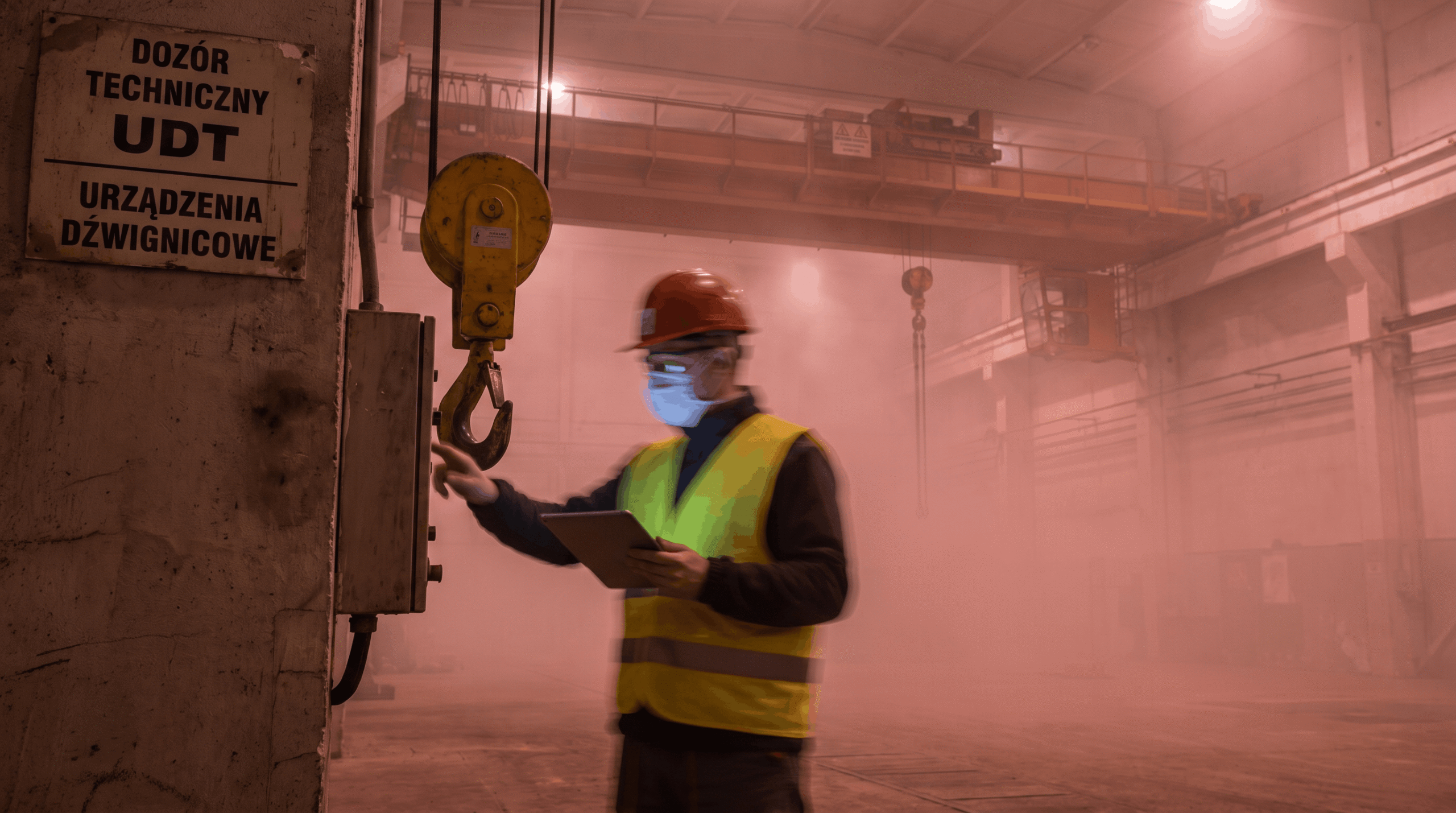
Technical supervision is statutory supervision of devices whose failure or poor technical condition may endanger life, health, property or the environment. Most cranes — cranes, cranes, hoists, lift tables, platforms — are legally subject to supervision by the transport equipment closest to them. For the company this means a specific set of duties: registration of the device, testing, maintenance and record keeping. This guide cleans up the subject from scratch. He explains what technical supervision is, what it is subject to, what its forms are, who is responsible for what, and what consequences threaten to operate the device without the required decision. It is a knowledge that will be useful to any company using lifting equipment, whether it is one hoist in the workshop or a crane park in the production hall. The most important thing in a nutshell. If you operate a crane, crane, electric hoist above 250 kg, lift table over 250 kg or mobile platform, your device is most likely subject to full supervision. It requires registration in the UDT, a decision authorising the operation and periodic examinations carried out by the inspector. Lighter devices — such as hand hoists or smaller equipment — are subject to simplified supervision: without registration, but still with the duty of performing inspections by an authorized maintainer.
What is technical supervision and who performs it?
Technical supervision is defined by the Act of Action to ensure the safe functioning of technical equipment which may pose a threat to human life or health, as well as to property and the environment. The principles, scope and forms of supervision shall be defined REGULATION OF THE MINISTER OF BUSINESS AND TECHNOLOGY) of 30 October 2018 Surveillance is carried out by specialised state units. The most important of these is the Office of Technical Surveillance (UDT) together with the field troops. Surveillance activities — tests, checks, equipment registration — are carried out by UDT staff called inspectors on the basis of a mandate and a service card. Transport Technical Surveillance (TDT) is appropriate for parts of the equipment. This applies, among other things, to short-distance transport equipment used in the railway area, at seaports and inland waterways, on ships and at port transhipment bases. For a typical warehouse or production hall, the competent authority shall be UDT.
What provisions govern the technical supervision of lifting equipment
Three legal acts form the foundation of the subject:
- Law of 21 December 2000 on technical supervision — determine which devices are subject to supervision, the obligations of operators and maintainers, and the penalties they threaten for infringements.
- Regulation of the Council of Ministers of 7 December 2012 on the types of technical equipment subject to technical supervision, indicates what is specifically under surveillance.
- Regulation of the Minister of Entrepreneurship and Technology of 30 October 2018. (Journal of Laws 2018, item 2176) on the technical supervision requirements for the operation, repair and modernisation of lifting and handling equipment — defines supervision categories, examination and inspection intervals, and introduced the concept of design working period.
What are close transport devices
Close transport devices are designed and used to move people or cargo for short distances. It is a category that includes most crane equipment found in industry and logistics. Close transport equipment includes, inter alia:
- cranes of all types,
- cranes — fixed, pedestal, mobile,
- hoists and winches — chain and rope, hand and electric,
- lift tables — including scissor and gear lift tables,
- mobile platforms and devices for the movement of persons,
- lifting and handling trucks,
- storage systems,
- freight and passenger cranes.
Practically the entire range of crane equipment manufacturer is included in this category — from Chain hoists and Scissor lift tables, by cranes, cranes and mobile elevating work platforms.
What are the forms of technical supervision
It’s a key distinction of the whole subject. The form of supervision determines how rigorous supervision covers the device, and thus how much responsibility rests on the operator. The form of surveillance for a particular device shall be established at the stage of reconciliation of its technical documentation; it follows from the Annex to the 2018 Regulation. The division into forms groups the equipment according to the risks associated with their operation. There are three forms of technical supervision in Poland:
| Form of supervision | Subject matter | Which includes in operation |
| Full supervision | High-risk equipment — heavy lifting capacity, high height or speed, lifting equipment for lifting persons or operated from a different level than working | Receipt, periodic and ad hoc tests; registration in UDT; decision authorising operation; checking of qualification certificates for service and maintenance |
| Limited surveillance | Medium risk equipment | Less scope than full supervision, but some periodic examinations are still required; registration and operating authorisation decision |
| Simplified supervision | The least risk equipment — e.g. hand-operated hoists and winches up to 2000 kg, single-phase electric hoists up to 1000 kg, manual cranes up to 2000 kg, portable lift tables up to 2 tonnes, all devices with a load capacity up to 250kg | No registration in the UDT and no decision authorising operation; verification of compliance with the regulations; still mandatory maintenance by authorised maintainer; ad hoc testing only after accident or failure |
How the full supervision differs from the simplified
The simplest way to put it is: full supervision is a device under the supervision of the UDT inspector, and simplified supervision is a device under the care of the conservator. In the case of full surveillance, the equipment must be registered and have a decision authorising operation and the UDT inspector shall carry out periodic tests. The simplified device shall not be registered and UDT shall not be notified of its use. However, this does not exempt from the provisions of the Technical Supervision Act. The operator must still have the technical documentation, ensure maintenance by a person with an appropriate qualification certificate, keep a maintenance log and perform the required measurements. It’s a common mistake. Many companies assume that simplified supervision means no duties. It’s a misunderstanding. Lack of registration is not equivalent to lack of maintenance. A maintenance unit with UDT privileges is necessary for every transport device, regardless of the form of supervision.
Which cranes require full supervision of UDT
The boundary between full and simplified supervision is mainly based on the load capacity and type of drive. The 2018 Regulation included simplified supervision, inter alia, of close transport equipment with a load capacity of up to 250 kg, excluding lifts and mobile devices. According to the information provided by PS Lift, full supervision of UDT requires:
- three-phase electric hoists with a load capacity exceeding 250 kg,
- single-phase electric hoists with a load capacity exceeding 1000 kg,
- hand hoists and winches with a load capacity exceeding 2000 kg,
- cranes with a load capacity exceeding 250 kg,
- cranes with a load capacity exceeding 250 kg,
- lift tables with a load capacity exceeding 250 kg,
- Self-propelled platforms.
Other equipment of this group shall be subject to simplified supervision. They shall require only ad hoc controls by the maintainer with appropriate UDT powers and shall not require a decision authorising operation. Attention. The above thresholds are indicative and correspond to the typical offer of lifting equipment. The form of supervision for a particular specimen is based on its technical documentation and operating instructions. In case of doubt, it is worth confirming the form of supervision in the manufacturer or in the UDT prior to operation.
What research does UDT
Three types of technical tests shall be carried out by the UDT inspector for devices under full supervision and limited inspection. Receiving test shall be carried out at the end of the assembly, under conditions of readiness for operation, before a decision authorising operation is taken. The inspector shall verify that the device conforms to the documentation, that its installation and use comply with the instructions for use and that the warning signs and instructions are legible. This test confirms that the device can be transferred for safe operation. Periodic examination are carried out in the course of operation of equipment subject to full supervision. Its frequency depends on the type of device and the form of supervision. Ad hoc examination shall be performed outside the schedule, after the accident, after upgrading, after the installation site has changed, after serious damage, after the rest of the life cycle, and as an accident or emergency test, after receiving a notification of a dangerous event. For devices subject to simplified technical tests shall not be carried out except for emergency or post-accident tests.
UDT and Maintenance Review — not the same
This distinction is a regular source of misunderstandings. The technical examination shall be carried out by the UDT inspector. The maintenance review is performed by a maintenance service — and this is an obligation independent of the form of supervision, for all transport equipment close to you. The frequency of maintenance inspections is derived from the manufacturer’s operating instructions or from the Regulation. Examples of review dates given by PS Lift are shown in the table below.
| Device | Review frequency |
| Electric hoists | every 90 days |
| Hydraulic shears | every 90 days |
| Jib cranes | every 90 days |
| Overhead cranes | every 90 days |
| Hand hoists | every 180 days |
| Hand winches | every 180 days |
| Suspension | every 180 days |
| Rack jacks | every 365 days |
| Hand trolleys | every 365 days |
| Workshop cranes | every 365 days |
Each inspection must be recorded in the device maintenance log.
What Resurs is and why it matters
Resurs is a limit for the assessment and identification of the technical condition of the device, determined on the basis of the number of operating cycles and load conditions during the intended service life, taking into account actual conditions of use. Simply put, it is the service life of a device expressed in its work that it can safely perform. The concept of ‘resursus’ introduced the 2018 Regulation. The service life shall be determined by the device manufacturer. The operating obligation is to track the rate of use of the resurs — in order to capture the moment at which the device should be subject to a special review.
What happens when you’re overcompensated?
After use of the resursus by the device or its operating mechanism, it is required to carry out — or commission — a special review, i.e. an assessment of the technical condition. This review answers the question of whether the device can still be safely used. An assessment of the technical condition may be carried out by a competent person, for example an expert, an establishment entitled to repair or upgrade, a certification body, a laboratory or a maintenance agent of close transport equipment with appropriate knowledge and equipment. If the resurs of the device is not known, the operator shall determine it on the basis of the current state of technical knowledge and good engineering practice. It is worth remembering that the UDT decision authorising operation is valid until the device’s resurrection is exhausted. Overshooting a resurs without performing a special review means that the device loses its foundation for legal work.
Who is responsible for technical supervision — responsibilities of the operator
In the regulations on technical supervision, the central role is the operator — an entity that has access to the device and assumes the obligations of the bill. Importantly, the provisions do not involve an exploitation role for a device or the property right on which it is installed. In the lease agreement, the parties may agree on how to perform their duties, including the share of the tenant, but the contractual arrangements do not change the legal status — the liability to UDT remains with the operator. The main obligations of the operator are:
- notification of the device to the UDT prior to operation, via the eUDT portal, and obtaining a decision authorising operation, for devices under full and limited supervision,
- the provision of maintenance by persons holding adequate qualification certificates, for all close transport devices, regardless of the form of supervision,
- provision of service by persons with appropriate rights, which in most cases applies to devices under full and limited supervision,
- record keeping — the maintenance log and the review book of the device, i.e. a set of test protocols,
- tracking the use of resurs and ordering a special review after it has been exceeded,
- preparing the test equipment in such a way as to ensure the safety of those performing it and to provide maintenance for the duration of the test,
- notification to the UDT that the device is being sold or withdrawn from service.
In the event of a change in operation, the new entity shall assume all the rights and obligations of the predecessor resulting from the decision authorising the operation.
What are the consequences for the operation of the device without supervision of UDT?
The operation of a device under technical supervision without a valid decision allowing the operation — or contrary to a decision to cease operation — is illegal. The consequences are both administrative and criminal. Administrative implications. In the event of a risk to human life, property or the environment being detected, and in the absence of reception studies, failure to carry out periodic examinations or negligence of a review related to the exhaustion of resurs, the competent supervisory authority may decide not to use the device. Criminal consequences. The Technical Surveillance Act contains criminal rules. In accordance with the Article. 63 Act, which allows a technical device to be put into service without a decision to allow it to enter into service or exploits it contrary to the decision to cease operation, is subject to fines or penalties for restrictions on freedom. In accordance with the Article. 64, the fine shall be fined by anyone who prevents or impedes the performance of technical supervision activities or does not comply with the obligation to notify the surveillance authority of a dangerous failure of the device or of an accident associated with its operation. The legal consequences come to a dimension which is not seen in regulations, and which for the company can be the most difficult — a stoppage. Disabled device means stopped operation and failed orders. For this reason, technical supervision is best regarded not as a burdensome obligation but as an element of the company’s operational continuity.
Technical supervision step by step — from purchase to operation
For a surveillance device, the full path to legal operation is as follows:
- Purchase and delivery of equipment together with complete technical documentation in Polish.
- Installation by a team with appropriate powers and the drawing up of a post-assembly protocol.
- Preparation of documentation and submit to the UDT branch an application for a test, together with two sets of device documentation.
- Application of the device to UDT — registration in the register is carried out as part of the preparatory work for examination.
- Receiving test made by the UDT inspector in the presence of an operator or a person authorised by him.
- Decision authorising operation — It is only after it has been obtained that the device can legally work.
- Operation with maintenance, documentation and resurs tracking.
- Periodic studies in terms of the form of supervision and the type of device.
The newly purchased equipment may only be used after the demand test at the workplace. It should also be taken into account that, after the application has been submitted and the UDT case number is given, it needs time to set a deadline for the examination — so it is best to start the formalities in advance. Where PS Lift supports the operator. The company has the power of the Technical Inspection Office to install, maintain and repair crane equipment. The PS Lift team prepares complete documentation, reports of the device to UDT on behalf of the client and the presence of a maintainer at reception. It also assists in the calculation of resurs and performs a special review after it expires. Details are described on the website Service — UDT and resurs.
Frequently Asked Questions
Is each crane device subject to UDT
Practically every transport device is subject to technical supervision — only its form varies. Higher risk devices, such as cranes, cranes, electric hoists and lift tables exceeding 250 kg and platforms, shall be subject to full surveillance, with registration and a UDT decision. Lighter devices are subject to simplified supervision — without registration but with mandatory maintenance.
How full supervision differs from simplified supervision
Full surveillance requires registration of the device in UDT, a decision authorising operation and periodic testing by the UDT inspector. The simplified supervision does not require registration or a decision, but the operator still has to ensure maintenance by an authorised maintainer, have technical documentation and keep a maintenance log.
Do the device under simplified supervision have to be reported to UDT
Nope. The devices under simplified supervision shall not require registration in the UDT or a decision authorising operation. However, this does not relieve the remaining duties — maintenance by a person with a qualification certificate, technical documentation and maintenance log.
How often do you have to review the crane equipment?
The frequency of maintenance inspections depends on the type of device, the form of supervision and the manufacturer’s instructions. For intensively working equipment such as cranes, cranes, electric hoists or hydraulic shears, a review is usually performed every 90 days. For handheld devices, the terms are longer — 180 to 365 days. The periodic examinations carried out by the UDT inspector shall have separate deadlines, depending on the form of supervision.
What is a resurs of a transport device close to
Resurs is a limit setting the technical condition of the device based on the number of operating cycles and load conditions during the intended service life. The operator shall carry out a special inspection, which assesses whether the device can continue to be safely used, after exceeding the wear and tear.
Who is responsible for technical supervision — owner or user
Responds to the operator — an entity that has access to the device and assumes the obligations under the Technical Supervision Act. The rules do not bind this role to ownership rights. In the lease agreement, the parties may share their duties, but this does not change the legal responsibility to UDT.
What are the consequences of operating the device without a valid decision by UDT?
The operation of the surveillance device without a valid UDT decision is illegal. The supervisory authority may decide to discontinue operation. In accordance with the Article. 63 Laws on technical supervision of the entry into service of a device without a decision by UDT or operation contrary to a decision to suspend shall be subject to a fine or penalty of restriction of freedom. The legal consequences arise from the cost of downtime.
Who can perform maintenance of crane equipment
The maintenance of close transport equipment may only be performed by a person holding an appropriate qualification certificate issued by the technical supervision unit. This applies to all close transport devices, regardless of the form of supervision.
Summary
Technical surveillance of crane equipment is not bureaucracy, but a system that protects workers’ lives and the continuity of the company’s work. Key conclusions:
- Most cranes are close transport devices and are subject to technical supervision,
- there are three forms of supervision — full, limited and simplified — differing responsibilities,
- simplified supervision does not mean no duties; maintenance by an authorised maintainer is always required,
- resurs determines the service life of the device; after it has been exceeded, a special review is necessary,
- the responsibility lies with the operator, and the operation without a valid decision of UDT threatens to stop the operation of the device and criminal sanctions.
If the UDT formalities, the calculation of the resurs or the preparation of documentation seem complicated, it is worth using the help of a partner with UDT permissions, who will carry out the device throughout the process. Contact PS Lift — We will help you order the technical supervision of your equipment.
Related articles
- Periodic review of storage racks — a complete guide
- Modern Uplifting Systems — Investment in the Future of Production
- The pole crane and the crane — the choice of system in intrahale logistics
Related product categories
Overhead cranes · Jib cranes · Chain hoists · Scissor lift tables · Bravi platforms and lifts
